I recently finalized my Diploma study in the NPA — this is my story.
More than 20 years ago, I moved away from Copenhagen to the countryside in search of a different life.
A life of self-sufficiency.
I was searching for a connection I did not even have words for. All I could see was that I would not find it in the modern life of work and consumption.
We built a house, and although I had planned to live a life with less debt and more freedom, our dreams got the better of us, and we ended up with a 30-year mortgage.
To protect the value of the house, we took out insurance, and to protect our income level, we paid union fees. To pay for all of this, we both worked full-time, bought cars, burned gas, paid for insurance, car repairs, and taxes, and bought takeaway because the time and energy needed for self-sufficiency had already been spent.
Too late, I realized that I had not moved at all. I was still living inside the same culture, which seemed to dictate my next move, and I had once again placed myself on the very treadmill I was trying to escape.
I tried doing both for a while — working full-time, growing vegetables, and feeding animals — juggling incompatible realities. But it was not the life of ease I had dreamed of. In fact, my frustration was now even greater than before. I was frustrated with my mortgage, tired from all the work, and still trying to figure out how to break out of the system that seemed to have a firm grip on me no matter what I did.
Permaculture became my turning point. It seemed to put words to all the feelings inside me.
I signed up for my PDC on Friland in 2020 — and from there went directly on to start the Diploma in what later became the Nordic Permaculture Academy.
In the Diploma process, you produce and deliver ten permaculture designs.
You are not only making designs and learning permaculture terminology, principles, and ethics — you are designing a new reality for yourself through every design.
It changed my life.
In the early stages of this process, I realized that my goal with the Diploma study was to find a way back to my original dream.
One with less complexity — fewer mortgages, insurances, cars, and all that follows.
My goal was to peel away these layers and dismantle the mechanisms of the treadmill.
And so, I started my first design.
On our 8500 m² homestead, the hedges produced large amounts of branch material. I had invested in a gas-driven woodchipper to turn it into woodchips, but I became increasingly aware of the poor input-output balance: large amounts of energy and fossil fuel were used to produce a relatively small amount of organic material.
The woodchipper also broke down several times, leaving me dependent on gas, spare parts, and mechanics. Again, frustration.
Inspired by nature and the way fungi break down wood, I designed a system that eliminated the need for the woodchipper altogether.
I cut the branches into wheelbarrow-sized pieces, using anything thicker than a thumb for firewood. The remaining material was spread across the chicken yard to maximize earth contact. The area was shaded and moist from a nearby downspout — perfect conditions for fungi.
Slowly, the branches broke down. Beneath them, the soil came alive with woodlice and other critters, which became food for the chickens. Their manure, in turn, stimulated bacterial breakdown and supported egg and meat production.
After the first year, I harvested more than 1 m³ of compost. Unfinished branches were simply left to continue decomposing. The sifted compost became good potting material, while the coarse leftovers were used on garden paths as woodchips.
My frustration disappeared. I was now interacting with fungi, chickens, and living soil through design — making connections and closing input-output loops.
I had not added anything new — only arranged existing elements in ways that created multiple yields. In permaculture, this is often referred to as 1 + 1 = 3: something new emerges through the interaction of elements.
That interaction is the essence of permaculture for me.
Something opened in me. My frustration turned to hope. The woodchipper was gone, and with it one small layer of unnecessary complexity.
Through my ten designs, I realized:
The simpler things are, the easier it is to interact.
The slower things move, the more space and time there is for observation and interaction.
The closer I get, the more I can sense, observe, and receive feedback from what I am creating.
Complexity became an observation point for me; simplicity became my guiding principle.
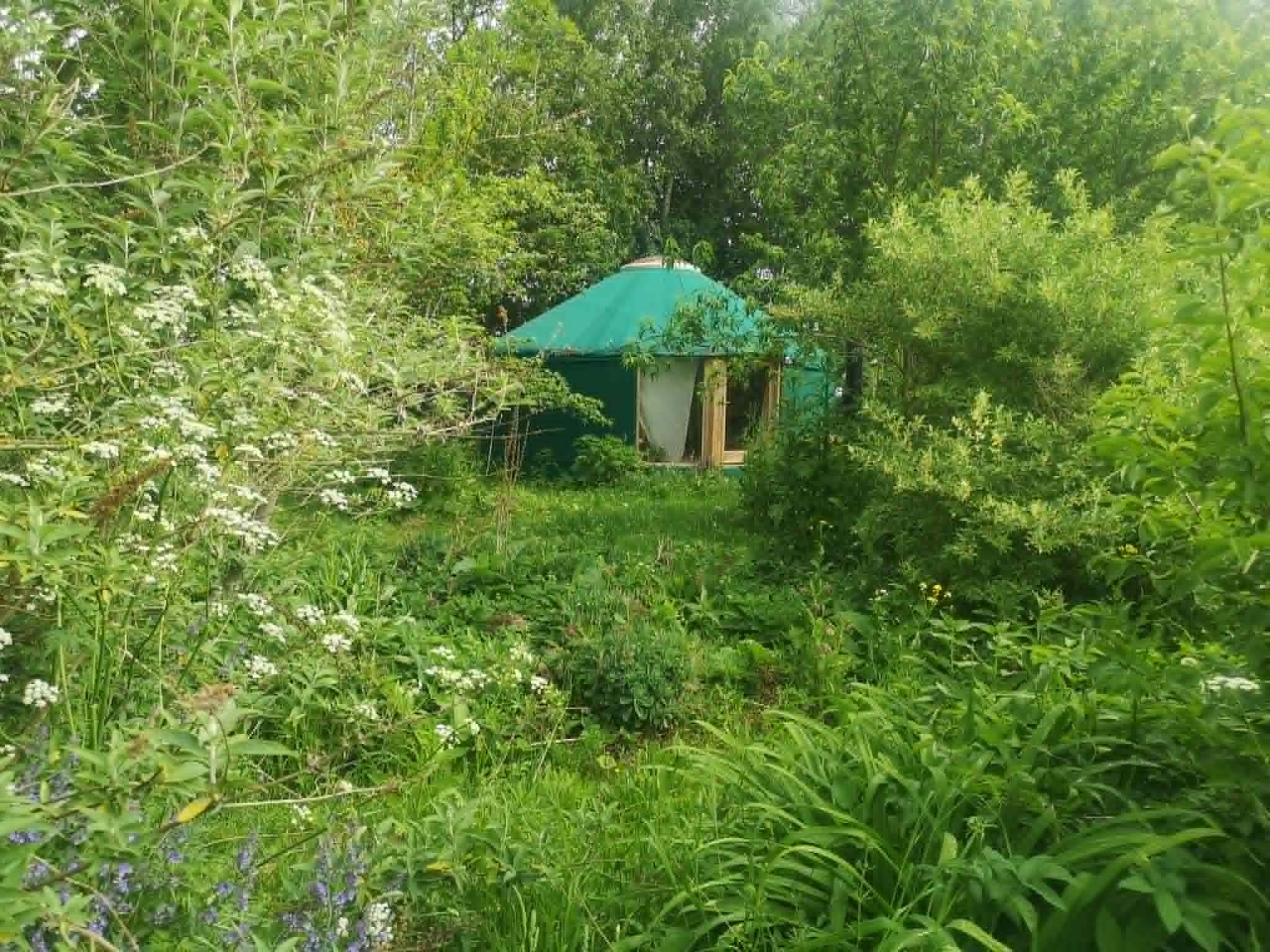
Life went on. I went through a divorce, though we all remained on the farm. I moved into a yurt with my new girlfriend — and for most of a year we lived largely off grid.
Building the yurt and living off grid was itself a design in my Diploma portfolio.
In the yurt, there were no buttons to press or taps to open; every need had to be met through my own effort. If I was cold, I chopped wood and lit a fire. Water had to be carried. Coffee required grinding beans by hand and lighting a fire.
It is not an easy life, but I discovered that the effort itself created gratitude. I appreciated warmth because I understood what it took to create it. I appreciated water because I had carried it. The simplicity of life made me more conscious of the things I had once taken for granted.
My habits began to change. I watched less television and listened instead to the rain on the canvas, telling me the garden had been watered. At night we could hear the fox barking in the meadow, reminding us to close the chicken coop. If the yurt was especially cold in the morning, I knew it was still too early to uncover the spring seedlings.
These small feedbacks brought me closer to nature, but also closer to myself.
Living in the yurt changed my perception of comfort. Sometimes it was only 10 degrees Celsius inside in the morning, and I would light a fire and wait for the warmth to spread. Over time, I became less concerned about this discomfort. Cold was no longer an emergency — only a temporary condition that could be met with action.
In many ways, modern society is built on the illusion of endless resources and effortless living, with buttons and taps that provide everything we need. But it hides the complexity required to create these resources, and it deprives us of gratitude for the little things — like rain on a canvas or the warmth of a fire on a cold morning.
The yurt cured me of this illusion, and I found myself happier than ever.
There are many other designs I could talk about here; they all helped shape the life I am living today.
I quit my full-time job, which has made room for more self-sufficiency, more time in the garden, and a happier version of myself.
Today, I grow most of my own food. I also stopped paying union fees.
I still have my mortgage to pay, but I am no longer frustrated, and I no longer feel hopeless, because I know I can design the life I want to live — peeling away the layers of complexity one step at a time, towards a simpler and happier life.